
Posts in: latest-content

Latest content

Vance and Hines FP3 Fuelpak Review

Customs Customs Customs

Vance and Hines FP3 Fuelpak Tuning System Review

How it started

My decision to get the FP3 over my original Screaming Eagle tuner most likely comes down to a meercat, like interest in new technology and my love for analysing things. The thought of being able to mount my iPhone on the handlebars [I have a nifty little mount from Roam Accessories] and being able to watch all the performance telemetry was just mind-blowing.  We all know Harley Davidson’s don’t give the most holistic info on the centre console, and here was a product promising me a view of the inner performance of my machine. The draw when I open the throttle in numbers (Not sure what you mean), the analysis of fuel performance, and of course, the ability to refine the tuning without the cost associated with a garage tune-up,  or the need for expensive computer software  and wiring harnesses; I was sold.  A benefit I’ve not yet explored is the ability to fault-diagnose using this tool; the ability to view live engine parameters will certainly speed up investigations in future.

Please hit follow on Instagram @thegirlonabike and Facebook

Performance

Ultimately the FP3 does exactly what it’s sold to do. You can select the tuning desired, specifying your bike, and the configuration of exhaust and air intake you are running.  This can be done by selecting the manufacturer and model of  the system you have, and it does the rest for you. It’s designed to allow you to fully utilise the performance potential of your machine by tuning it to precision.

The app software is always utilising the most up to date information within the Vance and Hines database and reacting correctly.

Mr. Vance and Hines, from what I’ve heard, are rather particular and detail focused guys and making sure the tuning is absolutely spot on is something they’ve nailed. The database is kept current and rest assured that whatever system you’re running you will be able to tune it successfully.
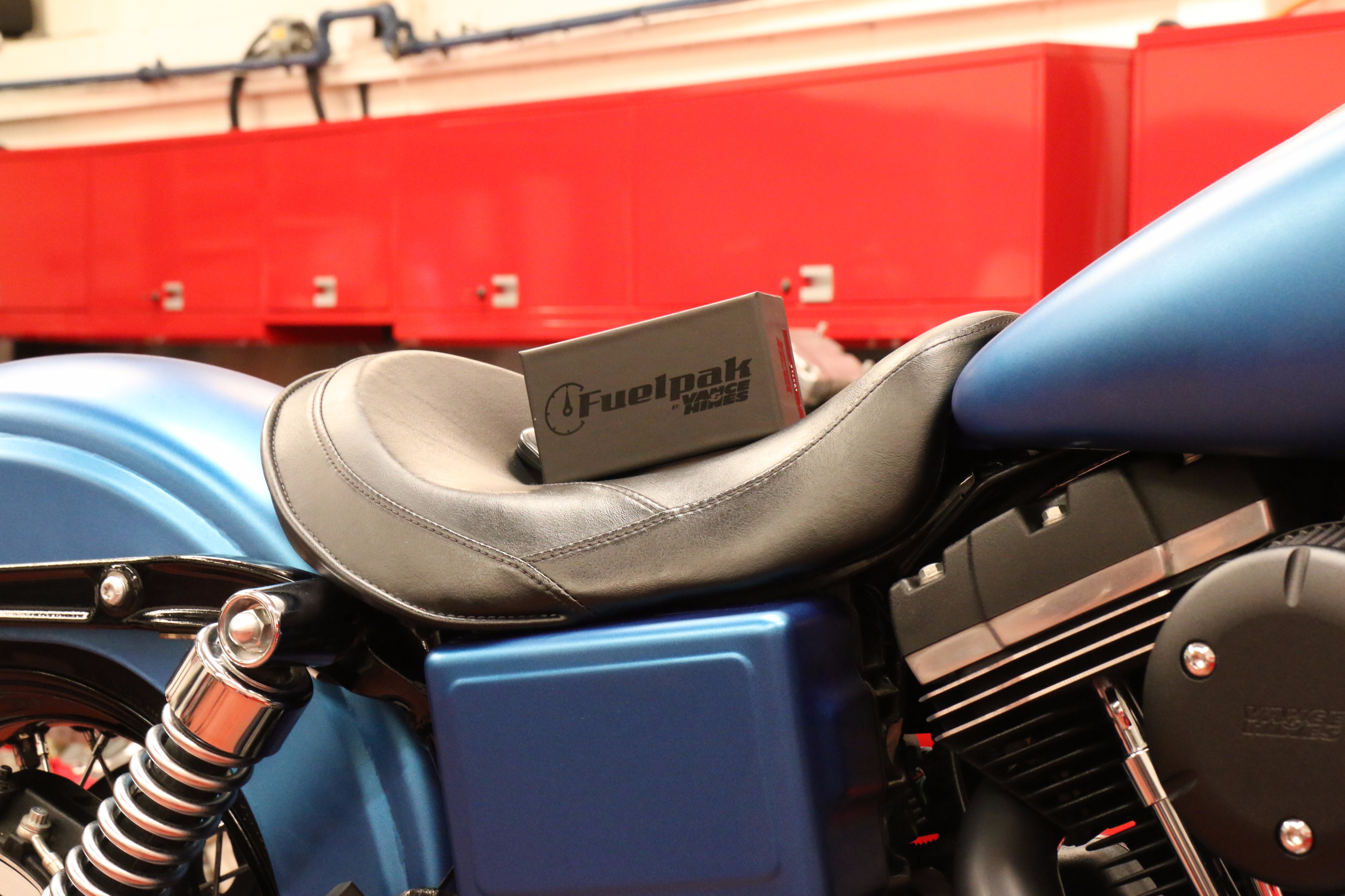
The pre-set tuning options are all for higher performance items, for example, the Crusher Performance air intake. However, it is possible to tune with stock items too. For example, you’ve upgraded your pipes but not your intake. Here you need to use the Auto-tune feature; you plug it in, turn it on and ride. The system will then monitor all the sensors, tuning as your ride, and let you know once it’s done. It’s magic. If for any reason, you can’t ride long enough for this to complete you can shut down and continue next time. This feature, of course, requires you to keep the unit attached while riding.

The auto-tuned feature also provides you with another layer or precision tuning for specific requirements, such as unique components [maybe you’ve got custom made pipes], or different grades of fuel.  This setting utilises all the factory sensors to find the optimum set up, all very cool!

Some fields you can change are front and rear spark advance, air-fuel ratio, front and rear cylinder VE, Acceleration and Deceleration enrichment/Enleanment [aka pop], idle RPM, rev limit and ACR (automatic compression release).

One of my favourites is the ability to adjust the deceleration pop. For me, I absolutely love the pop from excess fuel in the pipes igniting, however for those wanting slightly more civilised sounds you can reduce this. Or of course, increase it as I did! Pop pop pop!

It’s worth noting that, as with all tuning systems, it will only work on one machine. The fuel pack will link to your VIN and can thus only be used on an individual bike.

Look & Styling

As a tiny plug-in device it will fit within your battery case and be invisible. Or you can plug in, tune and remove it. I like having it plugged in as the monitoring gauges are sweet for visuals when you’re riding along. That’s the inner geek in me.

Build Quality

It’s Vance and Hines. It’s spot on!

Ease of Installation
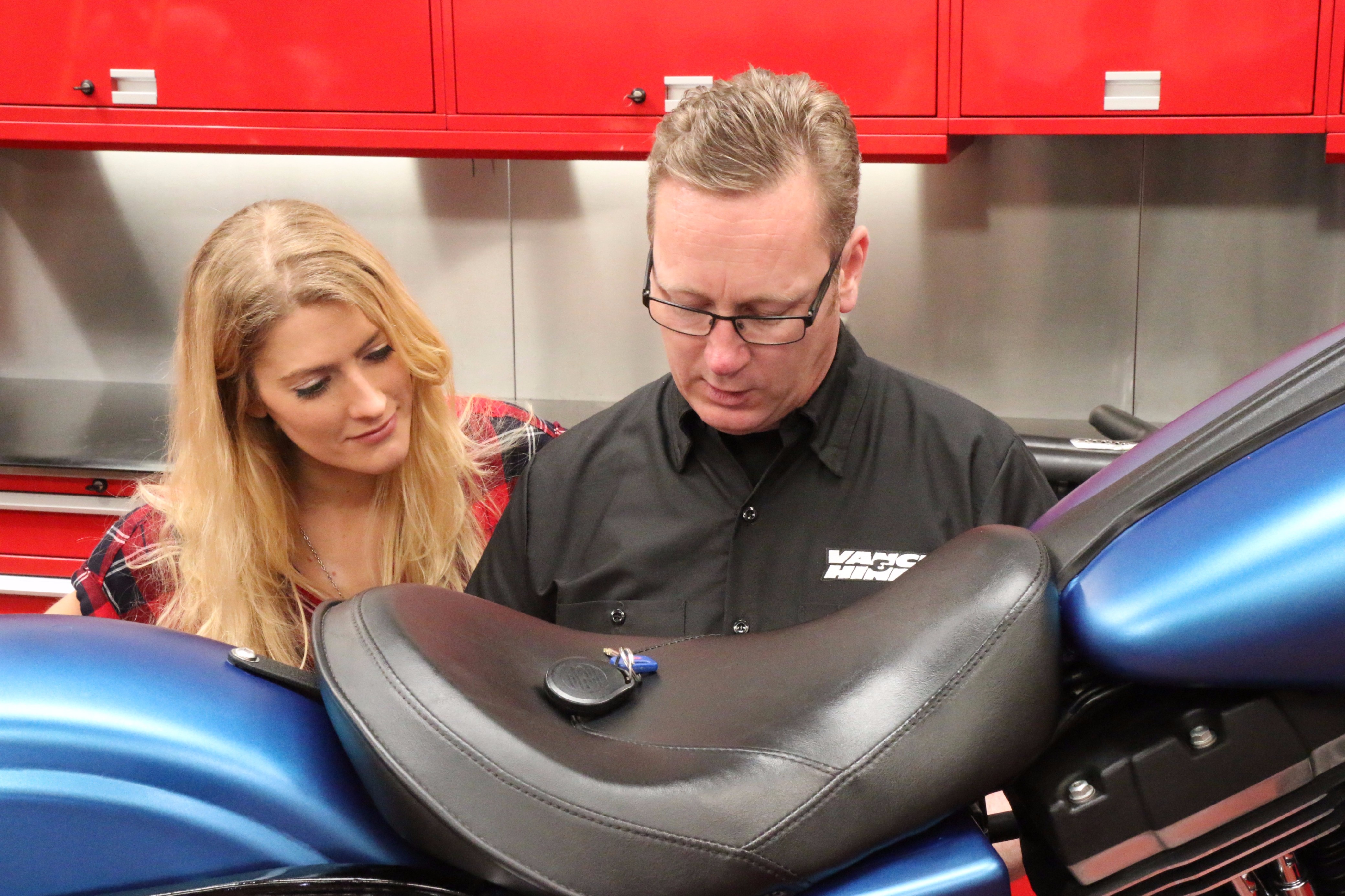
You plug it into your machine, download the app and connect via Bluetooth, and you’re away. The app provides a list of all the custom parts you could tune to, or you can opt for the auto-tuned option and let the factory sensors do the work for you.

It’s a pretty new product to market, and while Vance and Hines have a comprehensive FAQ section on their website, there doesn’t seem to be extensive user guide yet.  But in all honesty, I don’t think you’ll need it. The systems are super intuitive, really user-friendly and ultimately, easy to use. Yeah, it will take you a few minutes to figure your way around the app, but that’s pretty standard.

Crowd Reaction

Being able to show your engine stats on your iphone is pretty unique. It’s a nice little conversation topic. Plus, its ace being able to tune for the type of riding you’re doing or simply crank up the sounds for head turning.

Ultimately though, no one will know you have an FP3 Fuelpak unless you tell them.

£££

You’re looking at around £250-£300. It’s an essential if you’re upgrading parts of your system so why go with the hold when you can have the latest Smartphone tech. The extra money you spend buying it over others available, you’ll save in the ability to re-tune yourself without having to go to the dealer.

Highlights

  1. Simplistic, user-friendly interface
  2. On the go monitoring gauges
  3. Negates the need for a dealer to retune

Tips from Experience

  • If your phone doesn’t see the Fuelpak immediately try unplugging it and restarting your Bluetooth
  • Finding space for it can be tricky on some models, if so, pop it on, tune and then remove it
  • Keep the FuelPak safe; it’s only usable on your ride once paired as you can use it in the future to diagnose and tune

Overall Rating

Compared to the market, the Fuelpak FP3’s ability to refine individual changes directly on your iPhone, the simplicity of its use, the magical auto-tune capability and of course the Vance and Hines reputation behind it, made it a nobrainer for me.

Latest content

Protective Heat Shield

I can do it, you can do it! DIY ‘Do It Yourself’ – for the Bike

Protective Heat Shield

How it started

Fitted heat shield to leather panniers Harley Davidson Street Bob
Fitted heat shield

I have a set of beautiful Harley Davidson panniers [similar to these] and with my former pipes, Vance and Hines ShortShots, which point horizontally backwards, they were all good. However, I decided to upgrade to the new 2-1 UpSweep pipes.

Everything was fine until a few rides in when I realised that my new UpSweep pipes, the clue’s in the name…yup, they point directly at my beautiful panniers! I’d successfully, in just a few trips managed to melt the bottom, thankfully nothing too dramatic, still totally functional and visually perfect from the outside.

But at this point I’m faced with three options;

  1. I either remove my panniers and live with a rucksack
  2. I remove my pipes, or
  3. I figure out a way to protect my panniers from the beastly pipes

Anyone that knows about my accident history will know that I’ve had a full reconstruction of my right shoulder and so carrying a loaded rucksack isn’t an option. Plus anyone attuned to riding will know that carrying a rucksack isn’t very pleasurable anyway, so that’s number one out! Oh and getting rid of the pipes, definitely NOT an option.

Poor melted pannier

It left me with finding a way to deflect the heat from the pannier in a cost-effective and efficient way as re-positioning the pipes or panniers definitely wasn’t an option.

I swiftly came to the conclusion that a metal plate spaced from the surface of the leather to allow air flow cooling was going to be easiest. There are loads of options online for plates but it came to me the everyday random DIY use checker plate would be readily available, and I know the local hardware store, ScrewFix sells aluminium checker plate. Cost effective, easy to source, and when it comes to heat conduction aluminium is a pretty poor conductor compared to many metals. Stainless steel would be the dream but the work intensity would increase due to its rock-hard qualities – hard as steel is a valid statement – plus it’s a pretty good conductor so it would likely end up in a scolding hot shield.

I got my idea; all I needed to do was make it! Here’s how I did it

Please hit follow on Instagram @thegirlonabike and Facebook

Tools Needed

  • Aluminium checker plate
  • Disk Cutter [protective glasses, gloves, mask & ear defenders]
    • Metal cutting blade
    • Metal sanding blade
  • Drill with
    • Screwdriver head [match your bolts]
    • Metal drill bits in 3 sizes [small, medium, and large – large being size required for desired bolts]
  • Nuts and Bolts [I used 3x 8mm]
  • Washers [for use as spacers – I used 4 per bolt]
  • Spanner
  • Vice or Clamp
  • Hammer
  • Wood scrap for use hammering
  • Cardboard and sharpie

The Recipe

Make a cardboard template

  1. While pannier is attached, mark pannier where centre, top and bottom of pipe exhaust hits
  2. Remove pannier and make a template plate using cardboard to ensure the areas marked are covered with excess on either side. At this point think about the look you want to achieve, do you want curves, swooping lines, aggressive edges, or even a funky shape? Get it right in cardboard before you crack on
  3. Cut out cardboard template and mark where the folds will be required
  4. Test template on pannier until you’re completely satisfied with the shape and position, and be aware of where the bolts will go – you might want it to be a fraction larger to align with an existing pot rivet that can be drilled out, you can utilise holes and avoid adding holes that will affect its structural integrity.

Cut Aluminium

  1. Transpose template onto your aluminium plate, be sure you’ve got it the right way up
  2. Use disk cutter to cut out the shape and then the sanding disk to smooth
    and curve the edges to remove any sharp points. Remember to wear your safety gear!
  3. Align plate on panniers and confirm it’s right, then mark where you need your folds – if you must do a curved fold like mine cut a triangle out on the bend to enable the fold to happen in two parts [or more if needed]

Fold aluminium plate

  1. Aluminium is a super soft metal, and so with a firm hand, you can literally manipulate it. Pincer the aluminium in your vice and then, using cardboard to prevent scratches, position a piece of wood on the folding edge. Gradually apply consistent force across the full fold line, using a hammer if needed. The ideal is making the whole fold in one, so it’s a continuous line, avoid doing a bit at a time.
  2. Hold up your new plate to the panniers and continue to adjust the fold until you,re happy with the result
  3. You’re now ready to attach it

Attach your new heat shield

  1. Align your shield and mark where the bolts will go, do one bolt at a time
  2. Drill your first hole. When drilling aluminium always start with a small drill bit to minimises jumping and ensure accuracy, then switch to a medium size head, before finally drilling to the diameter of your chosen bolts – I used 8mm
  3. Align your hole with the pannier and drill your pannier using the same gradual method
  4. Put a bolt through your new holes with washers between the pannier and plate – this will provide the gap needed for heat disbursement. I used 4 washers
  5. Once you’ve got one bolt through you can then mark through the inside of the pannier out to where you need to drill the next aluminium hole. Doing one at a time ensures they’ll always align
  6. Repeat the process until you feel your plate is secured. I used three, top, middle and bottom

Test Heat Shield works

    1. Refit your panniers with their sexy new plate, turn on your bike and check if the exhaust is hitting the centre of your plate if it’s not you probably need to start again
    2. Go for a ride and check the plate and internal pannier temperature afterwards. If it’s cool, then your work is done! Mission success

Mission success

  1. Step back and enjoy, you now have

Time Required

2 hours

Ease of Completion

Simple cutting, shaping and bolting. Low skill set required.

If you’ve used a disk cutter before; then, this is a pretty easy task, no special skills needed. If you’ve not used one; just have a little practice on a scrap first, still a totally manageable DIY job for a newbie.

Crowd Reaction

Amazingly positive! I half anticipated stick for keeping my panniers and not just getting rid. However, it seems my fellow bikers are practical fellows. I’ve had a lot of comments that the panniers even look better on the plate and I should make one for the other side. Definitely a hit with the crowd, nothing fancy but simple and practical, it scores points.

£££

Super cheap! About £15 for the checker plate and I had a few bolts hanging about.

Highlights

  1. Saves the life of my panniers
  2. Workable solution for protective plates
  3. Looks ace

Tips from Experience

  • Drill your aluminium gradually, small drill bit, medium and finally bolt size to ensure accuracy and prevent jumping
  • Utilise any existing bolts or pot rivets on the panniers, drill them out and reuse where possible
  • The plate could be used to protect other areas of your bike, such as a tank, pannier, heel guard.

Overall Rating

A simple home fix to allow pipes and panniers to live in harmony, and it actually looks sick too. Winner.

Remember, I’m an account director in marketing…not a mechanic or engineer…so if

I can do it. You can do it!

Give it a go and give me a shout if you have any questions.

Latest content

Draggin Jeans Kevlar Motorcycle Jeans Review

Draggin Jeans Kevlar Motorcycle Jeans Review

How it started

Draggin Jeans Logo Kevlar reinforced jeans and clothing

I discovered Draggin in 2015. It was during my post-accident, and I was starting to commute to work during periods between operations when my body was able, and so I wanted something I could ride in but also wear in the office, out for dinner, be in normal life; having to change to get on the bike sucks. Something I thought was an impossible combination. But then I found Draggin in our local Blade Group dealer <link>, and the rest is history as they say. I now have three pairs of different looks, blue, dark blue and black, and I can rock up, get off my bike and not look like a biker in massive bike trousers. I wanted to look ‘normal,’ casual; it’s the ultimate look for the Harley too; safety without the safety look.

So how do I rate them?

Please hit follow on Instagram @thegirlonabike and Facebook

Safety

For me, this is really where Draggin Jeans stand out. They’ve been making motorcycle clothing since 1997; I was a wee kid back then! And, more importantly, they were actually the first casual motorcycle brand in the world to have ever passed the Certified European [CE] Level 1 and CE Level 2 certifications for Abrasion, Burst and Tear resistance. That’s a tested transmitted force up to 18 kN! Blimey. Now for me, that makes me feel protected!  [more on CE ratings here].

If you have any doubts, check out the below video. What better way for a brand to show their trust and confidence in their products; than by dragging someone down a runway in them! Secretly one day I’m hoping I can work with Draggin and do a video like this with me! I trust them that much – hint Draggin.

There are definitely loads of Kevlar jeans out there, but I feel Draggin have gone one step further with their latest kit. In the Draggin Twista jean, they have added a soft knitted lining made of Dyneema which is the world’s strongest fibre and DuPoint Kevlar covering the major crash zones. The lining takes advantage of Dyneema‘s amazing strength, which is 40% stronger than Kevlar and 15X stronger than steel! And they even have the option of extra pads for additional impact protection. For me, safety comes first, and these stats and features give me confidence.

Look & Styling

They literally look like normal jeans. Their earlier pairs had seam lines where the Kevlar was stitched in. However, the new kit doesn’t even have that. I’ve had many comments about me riding in ‘just jeans’, and it’s so unbelievably satisfying when you can turn around and say, ‘actually these are Dyneema Kevlar with a CE level 1 rating!’ Boom!

They have a range of designs, colour and styles. If you want skinny, baggy, boot cut, you name it, and I’m confident they’ll have them. Check them out Draggin Jeans.

Photos by Victoria Bowers

Ride Comfort

I’m not sure how they’ve managed it, but these jeans are just like normal jeans. Yes, they’re a little thicker due to the Dyneema and Kevlar. However, they have loads of flex, they hug the body, bend and stretch as you move. There are no worries about bending down to pick things up! I frequently wear them all day in the office simply because I can, and changing is such a pain! They’re that comfy.

If I go away on the bike, I tend to literally only take my Draggin jeans, plus some shorts if the weather allows.

It’s also worth noting that some of their newer kits come with a sports liner, which makes them breathable and ideal for year-round riding. Cosy in the winter and breathable in the summer.

Limitations

I’m clutching at straws here…

  • Not waterproof but what jean is… I simply carry a small pair of waterproof over trousers if there is any rain risk. Easy!
  • Draggin doesn’t do Dyneema Kevlar shirts yet – fingers crossed they might start.

£$€

 They’re definitely on the pricey side for jeans, but remember these are not just jeans. These are highly protective high-quality motorcycle trousers, compare their price to some leathers or other dedicated focus bike trousers, and suddenly they don’t look expensive.

Remember, you get what you pay for. Buy cheap Kevlar, and you’ll get cheap Kevlar.

Highlights

  1. Highly protective
  2. Super comfortable and flexible
  3. Look awesome, like normal jeans

Tips from Experience

  • Squeeze into the smallest pair you can. Given the nature of the fabric, they stretch; so you want to buy small and then when they give they’ll be the perfect fit.
  • Be gentle when washing, follow their instructions, and they’ll last for years

Overall Rating

Must have for any motor biker’s wardrobe.